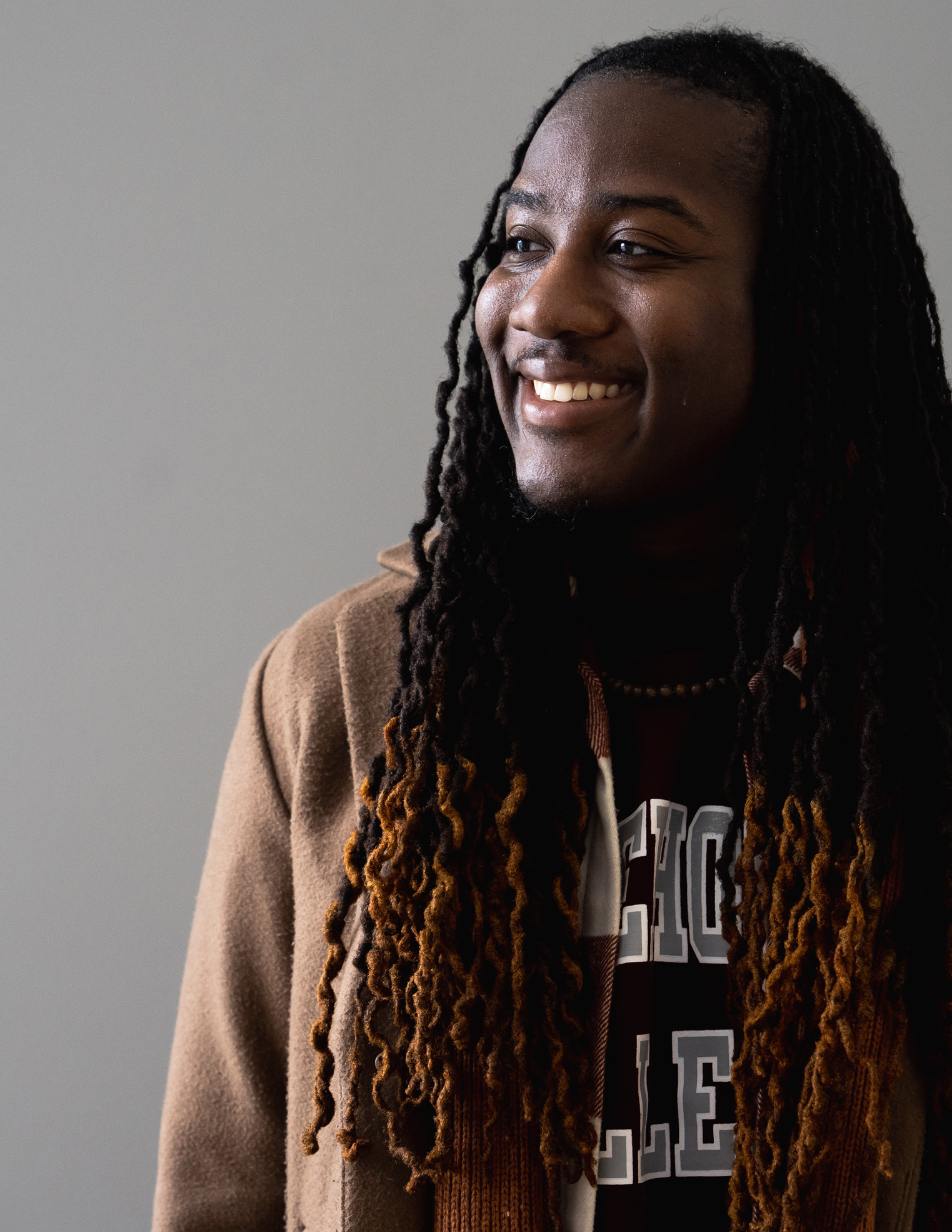
Rayquan Strickland introduces himself with the composure of someone who understands both where he stands and where he hopes to go.
“I am Rayquan Strickland, a junior music major with a minor in educational studies from St. Louis, Missouri,” he says.
Strickland, a member of Morehouse College’s Class of 2027, is part of a lineage of artists and educators emerging from the historically Black institution — young men who see music not simply as performance, but as a form of cultural testimony. That perspective animates his work both on campus and beyond it, including his contribution to the documentary Belonging Beyond Brown, directed by Dr. Nina Gilbert.
The film examines the evolution of Black educators and the enduring question of what it means to belong in American education. Its emotional center is underscored by Strickland’s original song, “It’s Time for Change.”
Yet the song was not written for the documentary. It found the film, almost by accident.
Before appearing in Belonging Beyond Brown, Strickland was a student in Dr. Gilbert’s course at Morehouse, where he heard her speak candidly about the complexities of producing the film. One particular challenge lingered: the music.
“She said that I have this film and I really want this song to go with it, but we’re having these copyright problems and it’s expensive,” Strickland recalls.
As Gilbert described the film’s narrative — tracking the transformation of Black education from segregation to the present — Strickland noticed a pattern in the language she used.
“As she was speaking, I kept hearing ‘change, change,’” he says. “Because she was discussing the changes that were taking place from segregation to now, from the teachers to now, from the students to now.”
In that moment, he remembered a song he had written years earlier.
“I said, ‘Well, Dr. Gilbert, I wrote a song a long time ago. I don’t know if you can do anything with this.’”
When he played it for her, the connection was immediate. The song’s themes of loss, resilience, and hope mirrored the emotional arc of the documentary.
Strickland wrote “It’s Time for Change” when he was just 15 years old. The song emerged in 2020 during a period of personal and national grief and reckoning.
“The story came after my cousin was murdered,” he says.
Confined at home during the pandemic and processing the violence unfolding around him from the killing of George Floyd to the loss within his own family, Strickland turned inward, searching for words that might make sense of the moment.
“I began to sit down and question, “what can I say about what is going on in the world today?” he recalls.
The lyrics that followed centered on a question both intimate and universal.
“When the song asks the question, ‘What do you say to a mother?’ you are always your mother’s baby,” he says.
The line draws on two painful images: Floyd crying out for his mother in his final moments and the grief Strickland witnessed after his cousin’s death.
“From 2020 when I wrote it to now in 2026, we’re still asking those same questions,” he reflects.
The song’s resonance would only deepen with time. In 2022, during his senior year of high school in St. Louis, Strickland survived a school shooting that took the life of a 15-year-old friend. This tragedy forced him to once again confront the issue at the heart of the song he wrote two years prior, how communities heal after loss.
Music had been part of Strickland’s life long before these moments of crisis. Raised in the church, he learned to sing as a child and began playing piano around age 12. At Morehouse, his musical life expanded further through the college’s storied Morehouse College Glee Club, one of the nation’s most celebrated collegiate ensembles. He explains that performing with the group reinforces the sense that music can carry both history and responsibility.
After writing the song, Strickland performed it publicly for the first time in 2023 at the Fabulous Fox Theatre in St. Louis, sharing the story behind it with an audience for the first time.
Now, through Belonging Beyond Brown, the song has found a new audience and a new context. The film’s exploration of belonging, representation, and education mirrors Strickland’s own journey from St. Louis to Morehouse, where he first began to see himself reflected in the educators around him.
For Strickland, the message extends beyond the documentary itself.
Strickland has a message he’d like to share with the readers of this piece: “I want to encourage them to watch the documentary, to understand what it means to belong — not what people tell you it means, but how you feel when you do belong.”
In many ways, that is what his song has become: a reminder that belonging is a feeling that emerges when voice, purpose, and community meet.
And when they do, as Strickland’s music suggests, change often follows.